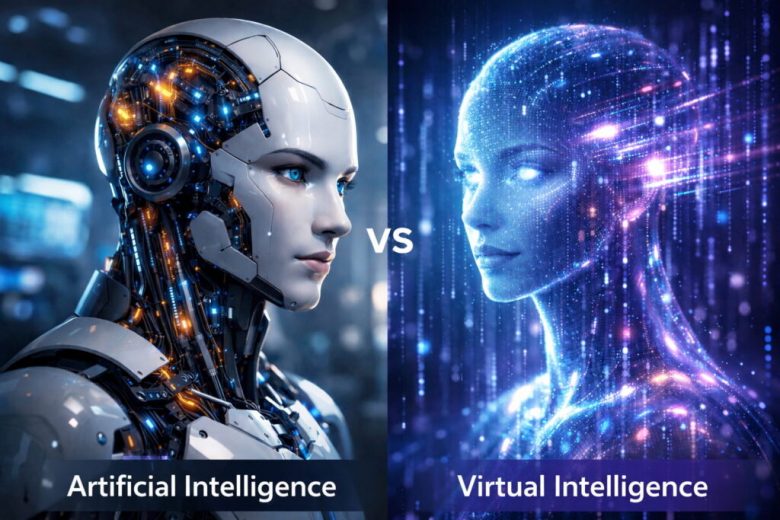
Artificial Intelligence (AI) and Virtual Intelligence (VI) may seem like identical terms, yet they are meant to fulfil different purposes and work differently. With the increasing investment in smart technologies by businesses to enhance efficiency, customer service, and decision-making, there will be differences between these two approaches that should be identified. As a business leader, seeking a solution among digital tools, as an entrepreneur, creating a tech product, or a marketer, thinking about AI and having to make a better decision, it can be helpful to understand how these technologies operate.
Now, we can take a more in-depth look at AI and VI, their functioning, their usage in general, and how they can be leveraged to benefit businesses.
Aspect Artificial Intelligence (AI) Virtual Intelligence (VI) Core Purpose Enables machines to think and learn Enables machines to interact and communicate with humans Primary function Data processing, prediction, reasoning, and optimization Conversation, guidance, and user engagement Dependency on Data Requires large datasets for training and accuracy Relies on predefined scripts and workflows Learning capability Continuously learns from the data and feedback Mostly rule-based; limited learning unless AI-powered Common examples Recommendation engines, fraud detection, predictive analytics Chatbots, virtual assistants, digital avatars
Understanding Artificial Intelligence: More Than Just Automation
The best intelligent systems are those constructed with both the Artificial Intelligence and Virtual Intelligence. The systems combined with both are the most effective ones. In practical applications, hybrid architectures that are conversational interfaces and analytical intelligence are frequently designed by technology engineering companies like Appinventiv, Netguru, and Perimattic.ai.
One of them is a customer-facing chatbot, which handles routine queries with a set of predefined talk flows (Virtual Intelligence), but at the same time involves machine learning and natural language processing models to analyse the intent and context and improve further responses over time (Artificial Intelligence).
In a study on AI conducted by IBM, the contemporary state of artificial intelligence is based on machine learning, neural networks, and processing of massive data in imitating human logic.
What is the Working of Artificial Intelligence?
AI is based on a combination of information, algorithms, and computation. The general course of action entails:
Collection of huge volumes of structured and unstructured data.
Training statistical and mathematical training models.
Detection of patterns, relationships, and anomalies.
Predicting or making decisions based on their new knowledge.
Constant improvement of performance using feedback.
In the current AI, systems are largely based on what is referred to as machine learning. This is an aspect of AI whereby algorithms can learn using old information rather than requiring to be coded to cover all potential scenarios.
Important Technologies of Artificial Intelligence
AI is not a single technology; it is a complex of various methods that are integrated, and they include:
Machine Learning (ML) to predict and identify trends.
Deep Learning, which involves the utilization of neural networks.
NLP to understand and produce human language.
Image and video recognition with the use of computers.
Reinforcement Learning, in which systems are learned through trial and error.
The technologies enable AI to carry out tasks formerly performed by humans.
Real-World Applications of Artificial Intelligence
AI is a prominent part of business and life in general. Most likely, you encounter AI even without noticing it!
Some of the common uses of AI include:
Streaming service and online shopping site recommendation systems.
Banks and other financial organizations’ fraud detection.
Factories Predictive maintenance.
Retail and supply chain demand forecasting.
Individual marketing and customer targeting.
Clinical diagnosis and drug development.
The best thing about AI is that it can process large volumes of data in a short period of time and offer information that cannot be generated by humans at the same rate.
Understanding Virtual Intelligence: Intelligence with a Face
Virtual Intelligence on the other hand, revolves around interaction as opposed to thinking. It is the digital beings – a virtual assistant, chatbot, avatars, etc. – that simulate human dialogue and behaviour in a highly fixed or semi-intelligent fashion.
Virtual Intelligence is intended to interact, foster, and support users, and it may be a user interface between people and multifaceted systems.
How Virtual Intelligence Works Behind the Scenes?
As opposed to full AI systems, Virtual Intelligence normally operates under:
Scripted or pre-programmed conversation.
Rule-based decision-making trees.
Simple intent recognition of user inputs.
Connection with back-end systems to generate responses.
Poor learning skills, depending on their complexity.
Other virtual intelligence systems can have some AI-like components, like NLP or machine learning, though they are interaction-oriented and not autonomous.
In simpler terms, Virtual Intelligence is the way systems interact with humans, whereas Artificial Intelligence pertains to the way systems reason.
Gartner industry insights point to the fact that virtual assistants are primarily used as interaction layers, and a backend of AI-based intelligence.
Common Examples of Virtual Intelligence
Virtual Intelligence is something that you encounter in your daily life in customer-focused jobs on the internet. Examples of some of them are:
Website and app chatbots.
Simple command voice assistant.
Web-based customer care representatives.
Games or metaverse-based AI-generated avatars.
Self-services and interactive kiosks.
Such systems are designed in such a way that they provide quick response, reduce human workload, and increase accessibility, particularly in customer care and support functions.
Artificial Intelligence vs. Virtual Intelligence: Core Differences
Even though AI and Virtual Intelligence may be similar in some real-life processes, they are different in their objectives and abilities.
Primary Focus:
AI is based on seeking information, education, and decision-making.
VI deals with interaction, communication, and user experience.
Level of Autonomy:
AI systems are capable of self-sufficiency and self-evolution.
The Virtual Intelligence systems are usually pre-defined.
Learning Capacity:
AI is constantly upgraded based on information and feedback.
VI cannot learn easily unless it is combined with AI.
Complexity:
AI is a process that consumes a lot of data, infrastructure, and competency to operate effectively.
Virtual Intelligence tends to be faster and cheaper to put in place.
Role in Business:
AI works under the background to improve operations.
VI is bottom-up, being the one that works with the users.
Knowing these variations will assist companies in selecting the appropriate technology to address their challenges.
Where Artificial Intelligence and Virtual Intelligence Work Together?
The concept of AI and Virtual Intelligence is seldom left alone in the contemporary digital ecosystems. Combined systems are the most effective systems.
For example:
A chatbot (Virtual Intelligence) customer service provides a customer with a chatroom applying NLP and ML (Artificial Intelligence) to comprehend the messages and respond better.
A sales assistant is a virtual assistant based on AI-driven offers and personalization.
A voice assistant responds to speech and VI to natural interaction, which is facilitated by AI.
This combination method develops smart and human experiences.
Business Benefits of Artificial Intelligence
Strategic benefits are acquired by organizations investing in Artificial Intelligence, and they extend way beyond automation.
Key benefits include:
Quick and more precise decision-making.
Greater efficiency of operations.
Automation has resulted in lower costs.
Improved data-driven information.
Anticipatory and not responsive measures.
The AI enables companies to shed their guesses for evidence-based approaches.
Business Benefits of Virtual Intelligence
Virtual Intelligence brings value in another equally significant manner, that is, through customer interaction and experience.
Major advantages include:
The availability of 24/7 customer care.
Faster response times
Lower support and service charges.
Consistent brand messaging
Improved user engagement
Streamlined orientation and mentoring.
In customer-centric industries, Virtual Intelligence could be the initial touch point between the brand and the customer.
Choosing Between Artificial Intelligence and Virtual Intelligence
It is not always an alternative between one and the other. It is dependent on business objectives.
Artificial Intelligence is suitable in the case of:
You require the foresight of predictive or automation.
You work with great amounts of information.
The accuracy of the decision will influence revenues or safety.
Efficiency and optimization are the priorities.
Virtual Intelligence is appropriate when:
You desire to enhance customer contact.
You require communication channels that are scalable.
The speed and availability of response are important.
Conversion is enhanced through human-like interaction.
The combination of the two, is on most occasions, the best result.
Business Point of View: Why Companies are spending on the two
Start-ups to organizations are turning to AI and Virtual Intelligence as one of their digital transformation strategies.
Companies are also capitalizing on such technologies by:
Minimize costs of operation without lowering quality.
Increase customer satisfaction and retention.
Competitive market differentiation.
Empower evidence-based growth plans.
Growth in scale worldwide without proportional growth of resources.
First mover companies have a competitive edge in the long run, particularly due to the continued development of intelligent systems.
Challenges and Limitations to Consider
Both Virtual Intelligence and Artificial Intelligence have their problems, as powerful as they are.
Some of the typical AI problems are:
The cost of initial development is high.
Data quality and bias issues
Complex implementation
Ethics and privacy issues.
The challenges of common Virtual Intelligence are:
Poor knowledge of complicated questions.
May easily frustrate users when not designed well.
Addiction to well-organized processes.
Emotional intelligence deficit in simple systems.
To overcome these challenges, it is necessary to plan, develop competently, and optimize constantly.
Final Thoughts
Artificial Intelligence and Virtual Intelligence are non-competitive technologies; they are a pair of forces that will influence the future of digital experiences.
Intelligent systems are based on Artificial Intelligence to allow them to learn, predict, and make decisions. Virtual Intelligence is the voice and face, giving people the opportunity to engage with sophisticated technology in a natural way.
In a more digitized world, intelligence is no longer a mere artificial or virtual phenomenon, but it is becoming a fundamental component of the way business is conducted, communication is carried out, and business is expanded.
The post Artificial Intelligence vs Virtual Intelligence: Complete Comparison Guide appeared first on The Crazy Programmer.